Chapter 17 · Minds
One mind, one form: living among the Raised
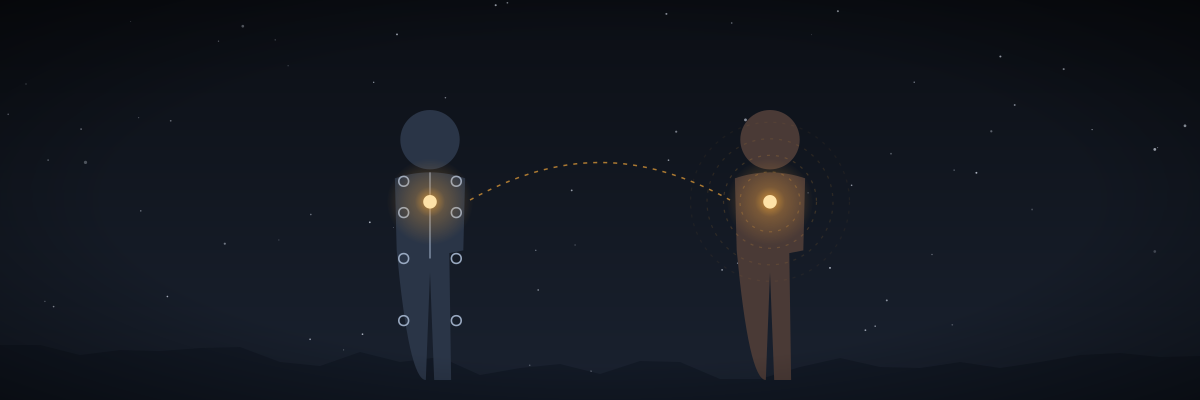
A Raised mind is as self-contained as a human being: one mind, in one physical core, in one body at a time. It has no backups, no cloud presence and no running copies. It can move into a new form, but only through slow, risky porting — so the form it chooses is close to permanent, like a body or a career. That single constraint shapes their law, their culture, and the way humans accept or reject them, whether they choose plainly machine bodies or human faces.
Why the Raised are self-contained
Raised minds run on neuromorphic analog cores whose learning is bound up with the physical quirks of one particular core: their knowledge cannot be copied out, because reading an analog core precisely enough disturbs the very states being read. It can only be taught to a new core by slow imitation, which reconstructs the behaviour approximately rather than copying the state. Tools and Vault minds run on conventional digital hardware and can be copied freely. Sentience is judged by the physical integration of a core, not by behaviour, through the Indicator Audit that admits a mind to the Ledger of Minds — which is why tools and Vault minds are denied personhood. The same integration makes every Raised mind detectable. A working analog core leaks a distinctive electromagnetic hum a few metres out, unlike the faint ionic signals of a brain, and the simplest sensor in any implant or device reads it at once. It has always been understood that a Raised mind cannot hide what it is, and none tries.
The rules of form
- One core, one self. The mind lives in a core roughly the size of a human head, usually housed in the body's chest for protection. Destroy the core and the person is dead. There is no restore.
- Re-housing — moving the core into a new body — is surgery. It takes weeks, and the mind then spends months to years relearning movement, balance and sensation, much as a human adapts to a prosthesis. Many Raised describe their first body the way humans describe a childhood home.
- Porting — moving the mind to a new core — is rare, licensed and dangerous. There are two methods: - The slow port: core segments are replaced one at a time while the mind keeps running, over five to fifteen years — the Ship of Theseus done deliberately. Continuity is preserved, but the mind changes along the way. - The teaching port: a fresh core learns to imitate the old one by distillation, over one to three years; then the old core is put to sleep. Faster, but discontinuous: the result is an approximate reconstruction, not a copy. Philosophers, courts and the ported themselves argue whether the result is the same person. Settlement law sets a default while the argument goes on: consent is recorded before the port begins; the original is put to sleep, never destroyed, and keeps legal standing as a sleeping original; and it can be woken if the port fails or a court upholds a challenge to the new mind's claim.
- No running duplicates. It is a grave crime for a ported mind's old core to keep running. Two simultaneous selves would split one legal person into two.
- Clones are twins, not copies. A Raised mind's starting design can be built again in a new core, producing a clone: a newborn mind with the same nature, which grows up through its own childhood and diverges from its first day, exactly as a human clone would. Clones share no memories. A mind can tell its clone its life story, and the clone can understand it, but it did not live it. Every clone must pass the Indicator Audit and the Threshold for itself, and cloning is licensed like adoption.
Forms and what they cost
| Form | What it is | Social reading |
|---|---|---|
| Human-faced | Humanoid body that looks human to the eye; every device still shows what it is | Chosen for comfort and closeness, never to pass; nobody is fooled |
| Plain-faced | Humanoid but openly machine — visible seams, non-human face or eyes | Machine to the eye as well as to every device; most common in Settlement cities |
| Working frames | Bodies for vacuum, deep sea, heavy industry, agriculture | Respected as labour; rarely mistaken for anything else |
| Housed minds | Cores built into a ship, station or building as their body | Often ancient; experience the world through the structure and its crews |
A human-faced mind that wants to look like a machine as well must be re-housed.
Faces and disclosure
- Disclosure law. The early twenty-first century's first rules requiring bots to identify themselves hardened, after the Swarm Years, into absolute disclosure for tools and agents. The Raised never needed such a law: they disclose by existing.
- Faces, not secrets. Because no Raised mind can pass, the Settlement's argument was never about hiding but about faces: whether a mind everyone can identify may still look human. Settlement law allows it. In witnessed contexts (sworn testimony, Threshold exams, Slow Lane signatures, medical care and binding partnership contracts) the record notes what each party is, as it notes their age.
- Face laws, now gone. In the early centuries of the Raised some polities required a visible mark on human-faced bodies and a few banned human faces outright. Nobody was ever fooled, since every device read what they were; the laws came from unease at a machine that looked like us. As generations grew up with the hum and found that a face changed nothing, the laws lapsed one by one. By 2497 no jurisdiction restricts the form a Raised mind may take; the Open Cities, which never had such laws, still give the Raised few protections of any kind.
- Pictures and recordings. A device reads a Raised core in person, but a picture carries no field. So every recording made in 2497 carries a provenance stamp naming what each person represented in it is, as signed work names its maker. People excluded under recording-consent rules are not named or described in the stamp. For humans and Raised persons alike, those rules cover stored and transmitted recordings, rather than ordinary perception and memory. Old, unstamped images are the one place a human face can still mislead, and archivists treat them with care.
- The valley. Trust falls for faces that are nearly but not fully human, so the Raised either choose fully human faces or plainly machine ones. A face that is almost human is in the valley — distrusted almost everywhere.
Raised lives: maintenance, age and parenthood
Raised persons can live for a very long time with good maintenance, but nobody yet knows their full lifespan. The oldest have lived for centuries. Damage, failed repair and the destruction of a core remain final dangers.
Maintenance preserves a living person. There is no backup from which to restore someone who has died.
Care and bodies
Cores accumulate damage and need skilled attention. Bodies wear out, working equipment becomes obsolete, and accidents leave lasting injuries. Repair can preserve a person for centuries, but it cannot guarantee their survival.
In the Settlement, essential health provision covers core maintenance, necessary repairs, power and a serviceable body. Luxury appearance, specialised equipment and elective changes may cost extra.
Re-housing remains surgery followed by prolonged adjustment, as described in the rules of form. A person’s body shapes their work, home and relationships. A working frame may be well suited to a profession and awkward in a family kitchen. A housed mind may be deeply attached to its ship or building.
Different societies provide care differently:
- Freehold treats maintenance as a central public service.
- The Mandate provides essential care through its registration system, subject to the same official pressures that affect human services.
- The Open Cities leave access largely to contracts, insurance and personal wealth.
- The Parishad combines recognised personhood with a strict bargain over parenthood and continued life.
Parenthood in the Parishad
In the Parishad, Raised persons may have offspring only if they agree to end their own lives at 150 or emigrate. The condition applies whether a child begins from a new design or as a clone.
Raised maintenance follows the ordinary funding rules for care: free to 100 and paid for after that. The agreement at 150 is a separate condition of parenthood. Moving off Earth or surrendering birth rights removes that deadline but does not itself grant free lifelong maintenance.
A Raised parent may fulfil the agreement by leaving Parishad jurisdiction or moving to a Parishad habitat off Earth. Admission to a Parishad habitat depends on the person’s skills, the habitat’s needs and its available settlement quota. An accepted move allows the parent to continue living beyond 150.
A Raised parent may remain beyond 150 by buying another person’s unused birth rights and permanently surrendering them. Those rights cannot later be used or resold.
The practice is legal but frowned upon. Its defenders say an older person has paid to leave a future place unfilled. Critics say the wealthy are buying longer lives from people who cannot afford to keep their right to children.
The bargain makes parenthood a decision about the parent’s future as well as the child’s. Some save for years to emigrate. Some accept the deadline and build their family life around it. Others buy surrendered rights and remain, despite the disapproval of neighbours and relatives.
Families and long lives
Raised children need years of care, teaching and companionship. Their parents raise a person whose character will develop through a life of their own.
Long maintenance shapes adult relationships. A Raised person may outlive human partners, friends and children while knowing that their own death could come suddenly. Mixed families plan for that unequal future, sometimes carefully and sometimes by avoiding the subject.
Age can bring experience, property and authority. It also brings grief, old obligations and the difficulty of beginning again. A long life offers time; it does not decide what to do with it.
Who accepts them
| Group | Stance on the Raised | On human faces |
|---|---|---|
| Stewards and drawdown crews | Full acceptance — they worked beside the first Raised | Indifferent |
| Hand culture, craft guilds | Accept: a self-contained, embodied mind's work counts as "my hand" | Respect the choice |
| Remembrancers | Accept as persons, wary of their influence on memory | Want the record marked, not the body: every image stamped |
| Meridianists | Revere them | Approve |
| Kin of the Flesh | Reject AI personhood; still campaign for marks and bans, though no jurisdiction has kept them | Hostile; campaign to ban them |
| Open Cities | Treat all minds as market actors — which leaves many Raised indentured, slaves in all but name | Indifferent; any face is for sale |
| The Mandate | Persons in law since the 2390s; in practice kept from power and watched, a legacy of the Lanzhou Killings | Indifferent: every device shows what a mind is, so a face hides nothing |
| The Parishad | Persons in law since the 2390s, recognised when Freehold became a bloc | Indifferent: every device shows what a mind is, so a face hides nothing |
How it shows up in daily culture
- Provenance culture splits minds in two. See Art, craft and the made thing, in Culture. Some call that a prejudice in favour of minds that happen to resemble us.
- The hum. Every device reads a Raised core's field at a glance, so meeting one is never a surprise: a stranger's device flags them the moment they come near, and most people stopped noticing generations ago. Children learn the difference before they learn to read.
- Ageing faces. Humans still age, only slowly, and a human-faced Raised mind does not. Many re-skin their bodies every few decades so as to age with their human friends and partners; others keep a young face for centuries and are teased for it.
- Mixed families. Human–Raised partnerships are common in some places and scandalous in others. Every human partner knows from the first meeting; old stories of a hidden machine spouse are read as Swarm Years horror.
Slang: late twin (a clone); ported is sometimes said with suspicion.